

Dear Art World:
What Does it Mean to Be Responsible for the Death of Things?

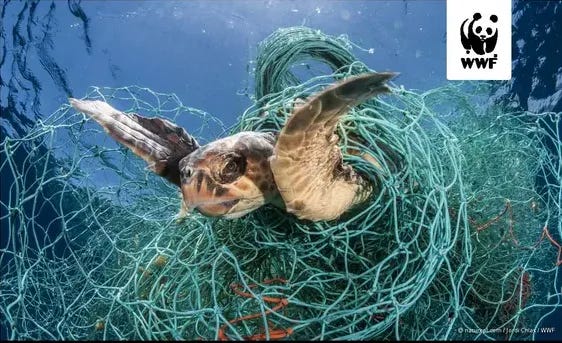
Every made thing has a death. The hoodie, the crate, the exhibition catalog, the polybag around the polybag. For my whole life, American law has treated those deaths as someone else’s problem, and we have always known who the someone else was. The landfill does not sit next to the sculpture garden. It sits next to somebody’s grandmother in East New York (side note: here’s a silver lining story about this example).
This is a newsletter about grief as infrastructure, so let me tell you what has been undoing me a little, in a good way, this summer: the law is starting to stay for the ending (of things).
This legal principle is called extended producer responsibility (EPR). Essentially, this law says that whoever puts a product into the world carries responsibility for its whole life, including its end. Cradle to grave, and then some accountability at the graveside. California has now written it into two laws, one for packaging and one, the first in the nation, for textiles. The fashion lawyer in me is thrilled about this legislation. But the sustainability strategist in the arts and culture sector in me wants to alert some of my favorite institutions about this law.
The California textile law crossed its registration deadline on July 1 while most of the art world was somewhere else. New York tried (again) this session and stalled (again) in June, which means the bill returns in 2027 with its definitions still soft like wet clay.
I have been circling this idea for years without knowing its statute number. When we started Sustainable Brooklyn, we insisted that fashion’s waste crisis and its justice crisis were one crisis, that you cannot talk about where a garment ends without talking about whose neighborhood receives it. When I built the Guggenheim’s first sustainability program, we diverted 89 percent of construction waste before any law asked us to, because staying with the material felt like the honest thing. Repair, salvage, reuse. Practices my people have carried for generations, out of necessity and out of love, are finally being translated into policy.
This transition is happening with or without the art world. I would prefer with.
So I wrote two guides.
The Rules Arrived Early is for arts organizations in California, where the rules are already enforceable and one deadline has already passed. It walks through what the two laws cover (your museum store is in there), how to repair a missed registration, and the two-year window in which the fee structures get decided by whoever shows up to the workshops.
Before the Ink Dries is for New York’s cultural sector, where nothing has passed and everything is possible. It maps the pending bills, what California’s rollout previews, and how institutions can get on the record in Albany in 2027. It is less a compliance document and more an invitation: the cultural sector holds more public trust than any industry that will lobby on these bills, and I want the arts and culture sector of NY to be in the room.
Both are available to download here:
California - The Rules Arrived Early
New York - Before the Ink Dries
If you work inside an institution, forward this to your retail manager, your registrar, your COO, whoever holds the loading dock in their mandate. If you are an artist, know that the practices you already keep, the mending and the salvaging and the refusing to throw away, are the ones these laws could reward if we make sure the formulas undergirding the systems prioritize them.
As humans, we have always known how to stay with endings. It is one of our oldest technologies. The law is just now catching up, and we are arriving at an exciting opportunity to be there when it arrives.
With you, in the wet clay,
Whitney
Using grief as a blueprint for infrastructure is a great way to breakdown SB707 and any EPR mandate in civilian terms. What I would like to share is that most working people have not yet learned how to fully embrace grief. We take off a few days of work for a funeral, a wake and then return to be cluttered with work again. Not enough time to process grief appropriately. And some of us spend the rest of our lives wondering if we should have taken more time off. Thats what I imagine the impact of this perspective can be. Designing anything made for end of life takes years to do. And that is what we need. Research, testing and evaluation. There are companies out there right now taking only 3 grievance days off to address this ERP thing. Not even processing thoroughly how it impacts their business and development in the long-term. We dont even have the infrastructure to handle the waste...yet. Alerting folks now, and not waiting for the hammer to come down is very smart. It is how they handle this throughout all departments, designer, artist to factory and production, legal, HR, sales and retail as you stated. There is so much more to unpack for these laws, you and anyone who has ever sewn a skirt from used curtains, will be happy, but as law - it is our institutions and clients that will have to answer for the death of things. Can you imagine, any sustainability graduate from 2025, has to relearn how to design for end of life once we've figured out proper material disposal from all the PFAS circulating in the system? The truth is, there is no proof of circularity of art or textiles on a massive scale.
If you have never attended a meeting for SB707, I encourage you to attend the next one in August. More than likely, NY will be anticipating the results and following along with Washington state. Thank you for providing the guides!