

Introducing SPIRAL
An Organizational Change Method for Cultural Institutions

SPIRAL
Survey · Plan · Inscribe · Root · Activate · Link
How to embed sustainability in a museum so it survives the next leadership transition drawn from examples of museum-wide cultural shifts towards sustainability.
01 — THE CASE FOR NOW
Sustainability is no longer a values statement. It is a compliance, capital, and credibility question.
Cultural institutions are being asked to decarbonize by forces that do not care about mission language.
In New York, Local Law 97 puts emissions caps and financial penalties on large buildings, and many museums are large, old, landmarked buildings. World Heritage and landmark designations narrow what you may change and how fast. Funders increasingly ask for climate commitments before they write checks. Artists, lenders, and the public now read a museum’s carbon footprint as part of its reputation.
At the same time, the sector has built real infrastructure: shared carbon calculators, exhibition climate commitments, and coalitions that pool compliance knowledge. And most of all, trust. The tools exist. What most institutions lack is not data or good intentions, it is a method for moving an entire organization beyond one green team.
That is the gap this guide addresses. It is the working method I used to take a museum’s sustainability effort from an enthusiastic green team to something embedded in contracts, workflows, budgets, and governance and I did it against real skepticism, inside the constraints of established institutional culture and an iconic building.
If you lead a cultural institution, or sit on its board, the question is no longer whether to act. It is whether your effort will significantly contribute to the relevance and sustainability of your institution.
02 — THE GAP
Why corporate change playbooks stall inside museums.
Most change-management models such as Prosci’s ADKAR and Kotter’s eight steps were built for corporations: clear hierarchies, profit logic, employees who can be redeployed. Cultural institutions break those assumptions.
Authority is diffuse. The person with the title is often not the person with influence. A long-tenured registrar, a trusted security officer, or the director’s assistant may hold more sway over whether change sticks than any executive.
The building fights back. Landmark status, World Heritage obligations, and conservation requirements constrain the obvious moves. Sustainability has to be designed within preservation, not against it.
Mission is the operating system. Staff are values-driven and allergic to anything that reads as corporate greenwashing. Change framed as efficiency lands flat; change framed as care for the work and the public lands.
Effort gets quarantined. A green team is a wonderful start but cannot be an endpoint. When sustainability “belongs” to a committee, the rest of the institution is relieved of responsibility. So momentum inevitably stalls, which can have deep ripple effects on the institution as a whole.
Turnover erases memory. When directors, managers, curators, and other staff members move on, commitments made in enthusiasm leave with them. Anything not written into contracts, standards, and governance evaporates.
So the method has to be different.
SPIRAL is a method that reads power before it acts, writes commitments into durable structure, distributes ownership into daily workflows, and only then asks people to become stewards of this work.
03 — ON THE NAME
Why a spiral?
The shape encodes how this work actually moves.
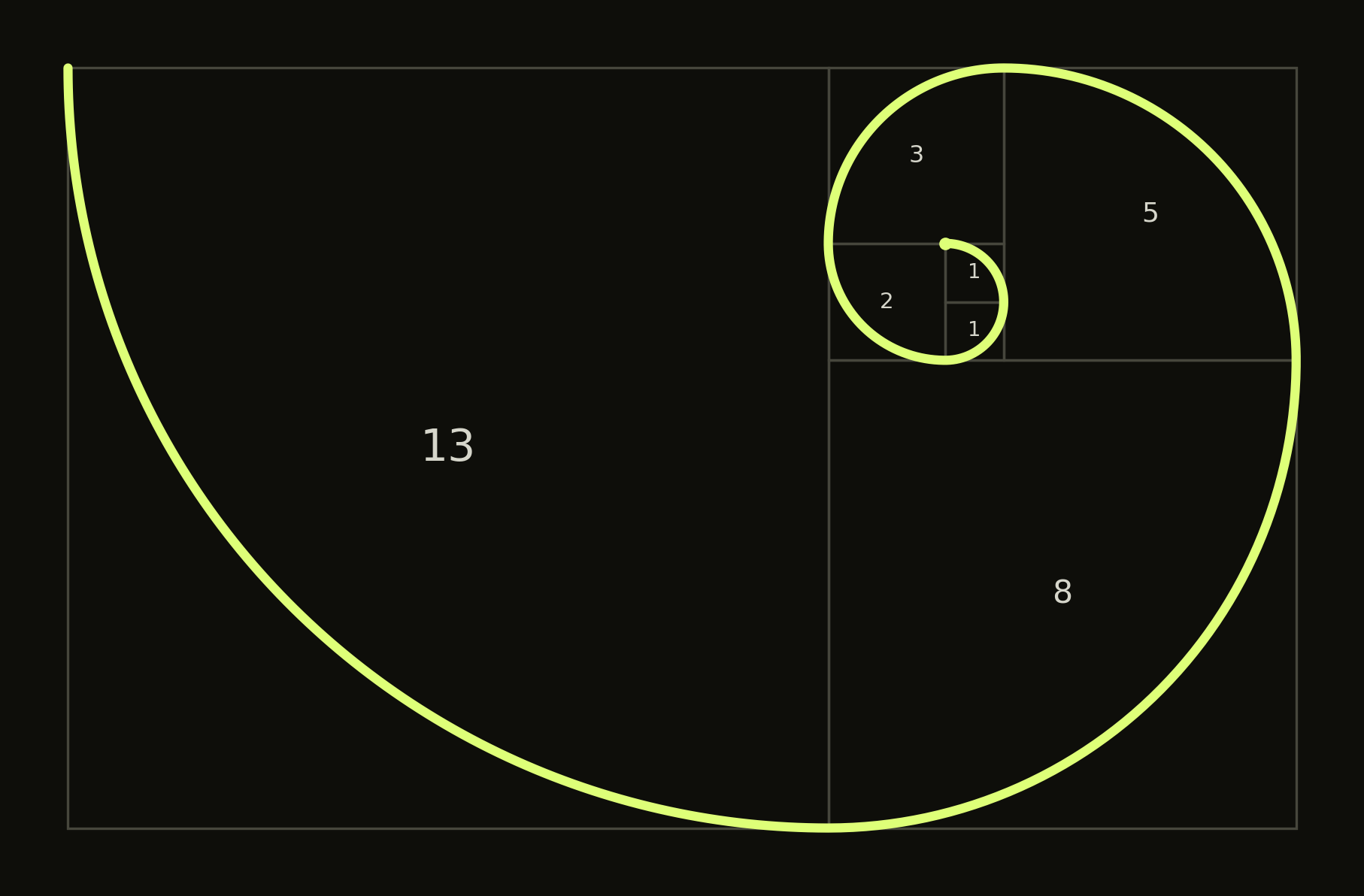
A spiral built on the Fibonacci sequence — 1, 1, 2, 3, 5, 8, 13, in which every number is the sum of the two before it — is the pattern growth takes when it is efficient: the sunflower’s seed head, the pinecone, the fern before it opens. For the McGuire Consulting Group, the spiral depicts what growth looks like when we never discard what came before.
This is also how durable change compounds inside an institution. Each stage of SPIRAL is the sum of the ones before. An institution cannot embody change that it has not inscribed or activate a strategy that has not been planned.
And like the spiral, the work grows outward while staying anchored to its center: hyper-local before global, reciprocal before extractive, building on the roles and relationships already there rather than imposing from outside. A circle only returns you to where you began. A straight line is indicative of the linear production model that undergirds extractive economic systems that have directly contributed to the massive waste problem we and future generations have been left to clean up. Ultimately, a spiral expands in proportion to its roots. This is the truest definition of sustainability we know.
The Fibonacci spiral — each square the sum of the two before it; the curve grows outward without losing its center.
04 — THE METHOD
The SPIRAL Method
Most change programs begin by trying to change minds. SPIRAL begins by reading the room and writing the commitment into the institution’s structure — then lets ownership spiral outward from the core to the community.
The order is the point: structure before behavior, inside before outside.
Keep reading with a 7-day free trial
Subscribe to The Sustaining Community Fund to keep reading this post and get 7 days of free access to the full post archives.