

May is for Remembering
A Grief Newsletter by Guest Author, Arielle V. King on Losing her Mother and Gaining Perspective


Hello sweethearts,
I’m adjusting the aperture of this month’s newsletters with a grief newsletter to close out the month.
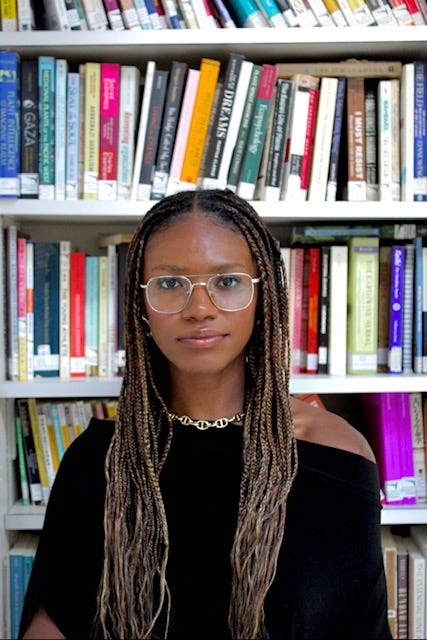
This grief newsletter features guest author, Arielle V. King, a NYC-based strategist, educator, and event producer with a background in environmental justice, law, and sustainability. She explores the intersections of climate, culture, and our interconnectedness to the Earth through media, impact-driven experiences, and creative collaborations. Arielle recently completed her first semester as an adjunct professor, teaching an Environmental Justice course at the George Washington University School of Law.
Enjoy the read. Until next month…take care.
Whitney
(FAQ: What does a grief newsletter have to do with sustainability, environmental and climate justice? And how does this relate to the work of The McGuire Consulting Group?
A: Read the first newsletter in this series for context.)
AVK: I once heard someone say that we should assume everyone we interact with is grieving something or someone. And we should try to treat everyone we meet with the requisite grace and kindness a grieving person deserves. I share this idea often because when I first heard it, I was experiencing tremendous personal grief, and I yearned to be treated with that level of care. When a person you love dies, it often feels like your world is ending and growing smaller by the moment. Yet the world keeps spinning, and the expectations of daily life don’t dissipate. As such, many of us are likely moving through the world trying to survive while carrying the tremendous weight of grief. We could all benefit from being more empathetic and more curious.
Grief is meant to be witnessed. And in a society where grief is often not acknowledged or held with the appropriate care it becomes an act of resistance and resilience to share about the hurt of loss and support others as they navigate and process loss. This act of resistance lessens the load of grief, and makes us all feel a little less alone.
I have been advocating for the protection of people and the planet for over half my life. This work often requires me to hold a tremendous amount of grief. Even so, I’m certain that even if someone hasn’t dedicated their life to this work, they still might be experiencing grief in some way.
Have you ever felt a sense of loss or helplessness in response to changes to the world around you– the disappearance of familiar plants and animals, the sea level rise, the lessening of green spaces, or the increase in wildfires or hurricanes? Have you ever felt scared about the future of the planet and the future that your children, your family, or all future generations might inherit?
When we experience a loss strongly enough, the natural human response is to grieve, and we call it ecological grief if what was lost, or what may be lost, is a part of our ecological world. When we feel ecological grief in response to the impacts and anticipated impacts of climate disruption - including feelings of despair, anger, fear, guilt, sadness, yearning, disorganization, and other emotions - that is climate grief. And that sorrow does not get talked about enough.
Grief is meant to be witnessed. Climate grief, like any other type of grief, must be named.
A recent American Psychiatric Association report found that one-third of Americans worry about climate change weekly, which means we’re extremely likely to interact with someone experiencing some form of climate grief on any given day. And because we’re human, it’s safe to assume we’re also carrying some other form of grief as well: the loss of a loved one, a relationship, a sense of safety, a job, anything. As such, it’s pretty safe to assume that we’re all grieving something.
In May of 2024, my world changed forever when my mom suddenly and unexpectedly passed away. She was my best friend, my loudest cheerleader, and my first role model. Esther Marie Patterson was everything– Chaka Khan’s I’m Every Woman often comes to mind when I think about the enormity of her impact and the boundlessness of her love.
Throughout my life, I watched my mom do and be so many things for so many people with grace, dignity, and love. She was a beloved community advocate and public servant who could light up any room with her bright presence, beautiful smile, distinctive laugh, and ability to make even the most mundane tasks fun.
My mom grew up in Brooklyn as the second of 6 children raised by a single mother. She endured unimaginable things growing up, yet she never let her circumstances harden her heart. Instead, she leaned into the value of helping others and being the person she wished she had during the hardest parts of her life. Her effervescence, zeal for life, boundless energy, and ability to balance seriousness with childlike wonder kept my mom joyful no matter what was going on. She enjoyed the little things in life, like beautiful sunsets, Ben & Jerry’s Chubby Hubby ice cream, park swings, and a good deal at Macy’s. She taught me how to notice and to savor the beauty in the small things: the rich colors that fall brings to the leaves, the cascade of pink, purple, and orange that make up a summer evening sunset, or how the moon glowed as it followed us home on night drives. She understood the power of unconditional love, and the impact being loved that way has on a person.
Whenever I would talk to my mother about a problem or injustice I saw taking place in the world, she would ask me, “What are you going to do about it?” In elementary school, that question led me to organize a bake sale to raise funds for the victims of the 2004 typhoon in the Philippines in the first grade, advocate for my school to start celebrating Earth Day in third grade, and collect almost a thousand hats, gloves, scarves, and socks to distribute to the elementary schools across my hometown in fourth grade.
For four years, she served on my hometown’s Board of Trustees, the only public office she sought because libraries had been her sanctuary since childhood. She was also a powerful advocate for birth justice and supporting young mothers. For over 25 years, my mom worked at a group home for pregnant and parenting teens in the foster care system. She spent countless hours staffing both day and night shifts, in addition to her full-time job, and standing by the bedside of dozens of teenagers as they crossed the threshold into motherhood. As the board co-chair for BirthNet, an organization dedicated to eliminating birth outcome disparities, Esther used her experience as a Community Doula (having assisted in over 80 births) to advocate for informed, respectful, and low-stress pregnancy experiences. This work has significantly contributed to the improvement of birth outcomes for people across the state of New York– including helping prevent the closure of the only maternity ward in all of Rensselaer County, Burdett Birthing Center; contributing to the successful campaign for New York State doula Medicaid coverage; and much more. The mayor of my hometown of Albany, New York, named June 14, 2024, “Esther Patterson Day”.
My mom’s life ended too soon, but it was an example of radical imagination in action that I’m so grateful I had the chance to witness up close. She saw the world for what it was and knew a better world was possible than what she was witnessing. She dedicated her entire personal and professional life to helping make that better world a reality, making countless people’s lives safer and more whole in the process. She didn’t consider herself an environmentalist, but she was my first introduction into caring for the planet.
And as more time passes, the grief forged from my mother’s passing has taught me lessons that I’m certain I will continue to learn from.
As someone who has spent the last few years encouraging others to practice climate optimism (or environmental joy) to combat climate doom, I’ve often found it difficult to carry so many types of grief at once since losing my mom. I grieve for the Black and brown lives sacrificed by unjust systems whose neighborhoods have been deemed unworthy of adequate protection, yet approved for the dumping of toxins and extraction of resources. I grieve for the loss of cultures around the world at the hands of climate collapse and the victims of senseless wars. I grieve for the future of our world and for all the wonders present. I grieve for future generations that will not be able to enjoy it because of the dangerous ways capitalism, patriarchy, and their causes and effects: greed and militarism, and white supremacy, continue to plague our planet. And at the same time, I grieve being able to call my mom, and I grieve the version of my life that existed before she passed away.
But the longer I live, the better I understand one of humanity’s superpowers: to hold and experience multiple emotions all at the same time. Grief and joy, skepticism and curiosity, hope and hurt, rage and wonder. That’s why I still choose joy amidst all the heartbreak and defeat. As painful as loss may feel, living on Earth is something we all have in common, and miracles, seen and unseen, happen on this planet every single day. Joy is not frivolous. It is essential for the continuation of movements. Joy must be at any movement’s core because, while powerful, fear, anger and even greed cannot sustain movements.
Joy is unshakable because it is what we get when we emerge from sorrow. We have to understand just how far both joy and sorrow can extend in our hearts and minds to begin creating better futures. And choosing joy is an act of rebellion in a system aimed at destruction, exploitation, and division. In fact, some experts worry that defeatism related to climate change can undermine efforts to take action, which may be just as, or even more dangerous, than flat-out climate denial. In other words, if we want to stay engaged in this work, we have a duty to choose joy– that indispensable force that can strengthen our resolve, help us uncover creative solutions, and bolster our resilience.
Radical imagination and climate optimism go hand in hand. In order to have the audacity to believe that a better world is possible while witnessing the craziness around us, it is essential to find reasons to stay motivated and optimistic. Joy is a statement to ourselves and the world that we are still here, undefeated. To achieve this, grief must be witnessed, and an essential part of grief is remembering.
May’s arrival will likely make me uneasy for the rest of my life. Year after year, May will bring Mother’s Days without a mom to call, and a reminder of just how precious our time on Earth truly is. Here and healthy one day, and gone the next. Fortunately, May often also brings the best of spring, and since my mom’s passing, I can’t help but stop and notice the beauty of the flowers that bloom. And the shades of green in the leaves that envelop the trees.
Last year, my dad and I spent the first anniversary of her passing, honoring my mom by visiting various spots around New York City that held significance to her life– like the hospital she was born in, old apartments, her favorite library, and so much more. It felt sacred and necessary to see and express gratitude to the places that helped shape her into the brilliant, beautiful, benevolent being I was raised by. It was nurturing to remember.
This year, on the second anniversary of my mom’s passing, I took the subway to Brooklyn to spend the day at the beach– a luxury I will always be grateful for as a New Yorker. My mom absolutely loved the beach, but because of her busy schedule, she rarely vacationed and never got to spend nearly enough time there. Now, I remember and honor my mom every time my feet touch the sand at a beach. I see her in the flowers that bloom in the spring. I feel her in the warm, gentle breeze of a spring New York City day. I keep believing a better world is possible because she taught me to.
Losing my mom turned my life upside down, but this grief has reminded me of the complexity of the human experience and the beauty of this world I’ve spent so much of my life advocating to protect. Grief is meant to be witnessed, so we must find ways to honor what and who has been lost. At my mom’s memorial service, my childhood pastor reminded us all that as long as we speak the name of the person we’ve lost, they’ll never truly die. So speak of your loved ones who have passed on often. And talk about the ecosystems and languages, and livelihoods lost.
- Arielle V. King
 | A guest post by
|