

What Do You Need?
Hint: It Might Be Death

In this issue, I am joined by Sara Chandler — strategist, program director, and writer — whose work lives at the intersection of physical infrastructure and the social systems that form along it. Sara came into my orbit through my Black Girl Environmentalist mentee, Amanda Eric. Below, Sara writes about environmentalism, identity, and the quiet grief of building a life organized around competence rather than need.
From Whitney
I am told that grief is meant to move through the body. It is not meant to be contained.
Many conflate grief with emotion, but in practice, grief is a series of conscious states that push us toward the acceptance of deaths — literal and figurative. I’ve let many aspects of myself die in order for other aspects to live. Four years ago, I walked away from a marriage because it had become acutely clear that I was facing an almost impossible ultimatum: continue to die a slow death of extraction and unlived potential for the sake of maintaining a family dynamic that society has told us is the most stable, or choose to live for myself — recognizing that when I do that, everyone around me thrives as well.
The choice became clear after I recommitted to writing. Through this practice, which has been my lifeline time and time again, I was able to excavate what I thought I’d buried: hope, funding streams, expressions of self that made me feel alive. I watched others bloom around me and thought that becoming was evading me.
I am still processing the audacious choices I’ve made as acts of reverence for myself and my life: closing my law firm, leaving the practice of law. Cutting off “friends” who thankfully revealed their envy and inability to have my best interest at heart. Leaving the Guggenheim. Leaving a marriage. Confronting family karma and my own mental and emotional stability, head on. Cultivating community in times of abundance and in times of scarcity. All of these choices required grief. And all of them helped me understand my purpose in this world.
I am a strategist, an architect of worlds, and a blessing — and I say that humbly. I know my worth. I know myself and I know what I am capable of. I can honestly say that through deaths, I’ve learned how to live.
I share all of this because grief, in my experience, does not arrive alone. It finds company. When I read Sara Chandler’s essay for the first time, I recognized something I hadn’t yet found the words for — the particular exhaustion of building an identity so complete that it becomes a way of not having to ask for what you need. Sara came to this through environmentalism. I came to it through the roles I kept agreeing to play. But the reckoning is the same: at some point, the architecture you’ve built to organize your life stops being a shelter and starts being a ceiling. What follows is grief — and, if you’re willing, something else.
Guest Essay: What Do I Need from My Climate Work by Sara Chandler
This story starts with discovering needs
I entered environmentalism with hesitancy. I thought the work might be boring. What drew me in was not the planet, at first. It was the people. While searching for my first role, someone told me: “People who want to help the planet are usually open to helping others too.” I fondly remember the first environmental lawyer I worked alongside — their smile, their laugh, the way they seemed available to the world.
If I am honest, those attractions were related to my needs, not the environment. I needed to be near openness.
Environmentalism became my way of expressing my needs without using my voice. It organized my identity into something legible and productive. I could care about climate change instead of saying I wanted connection. I could talk about systems instead of saying I wanted to belong inside one.
I was also drawn to any explanation of the environment around us. I knew my career as an attorney would be about explaining things — getting to the core of what is happening and how it is working in my favor or not. Attempting to understand the chemistry of things made me feel steady. If I could name the mechanism, I could orient myself inside it.
From Explaining to Embodying
And then I moved to Oakland, California and stayed long enough for the sidewalk to become something more than infrastructure.
After two years, I started noticing small shifts in my neighborhood. The new paint job on the corner house. The ADA-approved sidewalk installation. The elementary school’s sprinkler system turning on at 8 p.m. instead of dusk. I reported these updates to my friends, my partner, myself — like local news. I learned the fastest route to the biggest magnolia tree. I knew which neighbor might stop for a sidewalk chat. I began to notice how my parents and friends experienced my block when they visited.
These reflections brought me joy and new curiosities. Would my neighbor invite me to their garden? Will I ever feel as safe as they seem to? Why isn’t there a place to sit for someone on a long walk? Why do I take this route? They also brought a quiet recognition: I had not been feeling connected to my home before. Or to my place. Or perhaps to myself.
I realized that my environmental and sustainability work had always been a way of being. It shaped how I think: systems-oriented, collaborative, attentive to leverage points, obsessed with feedback loops. Those ways of being are still the future I want. I believe in community-centered approaches. In collective impact. In decisions made across differences. In research translated into action.
But I no longer want those only as professional competencies. I want them as conditions of my life.
Now, after a decade — in the midst of identifying what my next role will be — I am asking myself a question I hadn’t known how to ask before: What do I need from my climate work?
Perhaps this transition is not just professional.
Perhaps it is the grief of admitting that I don’t only want to explain interdependence — I want to live inside it. I want my work, my neighborhood, my family, and my needs to be in conversation with one another.
What I am grieving is how much of my environmentalism organized my identity — and how my understanding of my own needs flowed from there. I am grieving not having had the conversation with myself about what I needed outside of usefulness. I am grieving that being able to explain things only got me so far.
We are told that knowing what you need is simple. Listen to yourself. Trust your gut. But what if knowing what you need requires grieving the identity that kept you from needing too much — or needing something different?
Beneath my sidewalk in Oakland is soil.
Beneath what feels hard and fixed — like identity — is something dynamic, relational, alive. Soil does not function alone. It requires decay. It requires exchange. It requires time. It requires the willingness to be changed by what it touches.
My Challenge For Environmentalists like You & I
I think knowing what I need can be disruptive. Acting from that place is slower for me than building an identity around competence. It asks you to stay. To risk being known. To allow your work to be shaped by your life and your life to be shaped by your work. To let the chemistry change you.
How do we want to be?
How do we want to be in the future?
For a long time, I thought answering those questions required sharper analysis or better arguments. Now I think they require something else: the courage to reorganize our needs around interdependence. To normalize needing one another. To admit that explanation is not the same as belonging.
What do I need from my climate work?
Not just clarity. Not just impact. Not just the satisfaction of solving for complexity.
I need it to help me practice being inside the system I say I believe in. I need it to support a life where understanding does not replace intimacy, and competence does not shield me from stating my needs.
Beneath my sidewalk in Oakland is soil.
And beneath my identity as an environmentalist is something softer, relational, unfinished — still learning how to ask for what it needs.
—Sara Chandler is a strategist, program director, and writer whose work explores the social systems that take shape along physical infrastructure.
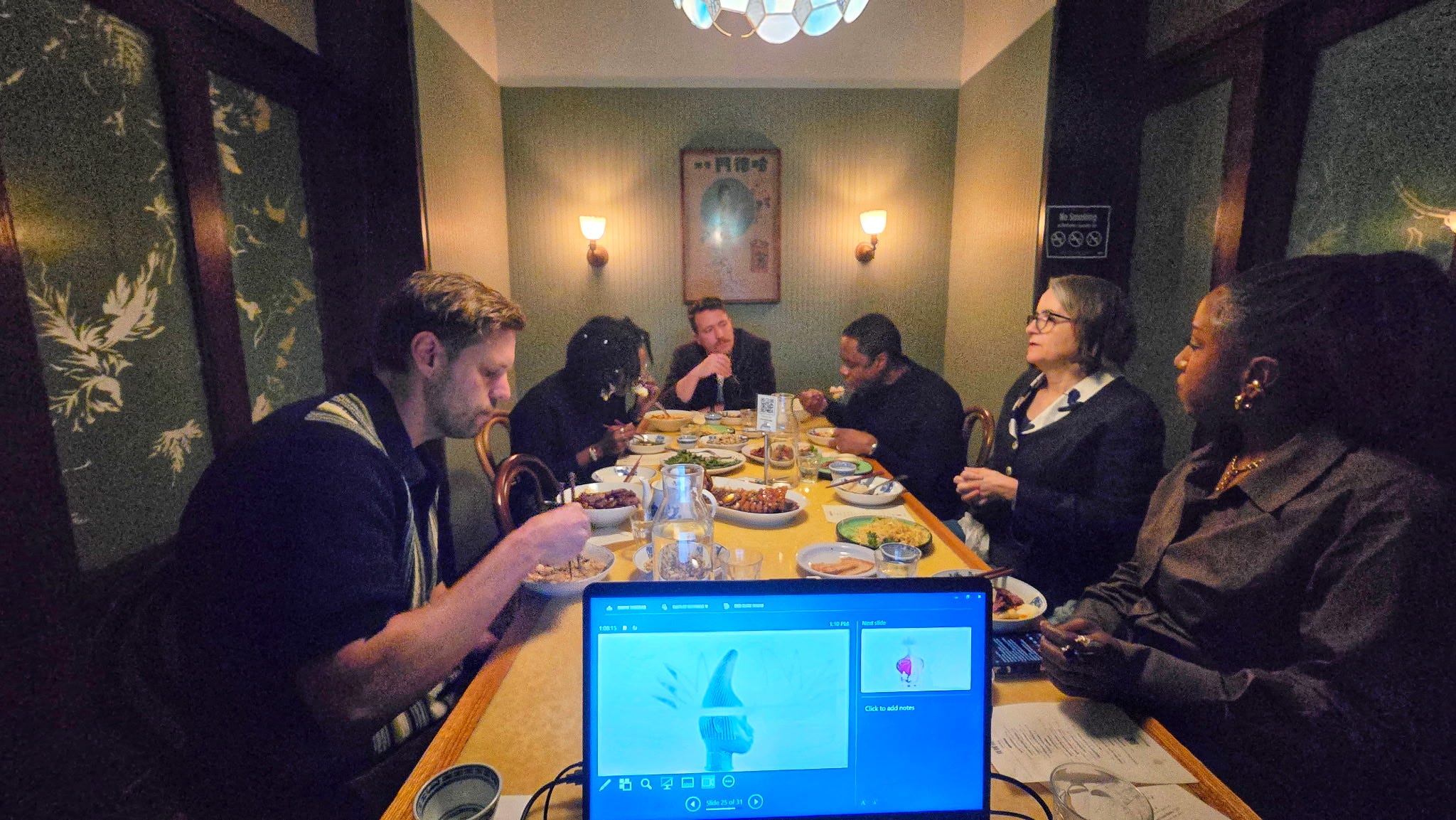
In the Room: Climate + Arts + Philanthropy Lunch, March 24, 2026
On Tuesday, March 24, Trepwise and The McGuire Consulting Group gathered an intimate group of leaders working at the intersection of arts, philanthropy, and climate at Cafe China in Midtown Manhattan. It was the third installment of an ongoing series — and the most generative yet.
Artist Jordan Weber anchored the conversation with a presentation on his practice, which centers regenerative land sculpture, ecological restoration, and deep community collaboration. What emerged was a framework many in the room had been circling for years without naming: that the work of building trust with communities over time is itself a form of convened governance — one that funders and institutions are only beginning to understand how to resource.
The conversation moved across terrain that felt urgent and unresolved in equal measure: how to create systemic deal flow that doesn’t replicate extractive patterns; what bioregional finance and design could look like when communities are at the center; how multi-solving frameworks could help philanthropists stop siloing climate from art from justice; and how to navigate political risk in funding decisions during an extraordinarily difficult moment for all three sectors.
The room was honest about the gap between intention and infrastructure. Good will is not a governance structure. Relationships are not a theory of change. And this moment — disorienting as it is — may be exactly when the architecture for something new has to be built.
We are continuing the conversation. If you are interested in being part of the next gathering, or in supporting this work, please consider an annual subscription. If cost is prohibitive, please reach out to me.
Transmuting Grief Into Action
This newsletter exists because grief, when organized, becomes something else. Below are five ways to move what you’re feeling into the world.
Name the death. Before anything else, identify what has actually ended — a relationship, a version of yourself, a belief about how things work. Grief without an object becomes ambient dread. Specificity is the beginning of movement.
Find one person who is in it with you. Organized grief requires witness. Not advice, not solutions — presence. Identify one person you can tell the truth to this week.
Turn the question outward. Both Sara and I arrived at the same place through different paths: asking what they actually need, not just what they can offer. This week, ask yourself that question. Write the answer down without editing it.
Resource something at the edges. Many of the most critical climate and justice organizations operate at the margins of institutional funding. Find one — a neighbor organization, a frontline group, an artist working in your community — and send what you can. PoliBot is one way to support that work.
Stay in the room. The hardest part of collective grief is not showing up once — it’s returning. Whatever gathering, community, or practice holds you: go back. Let the chemistry change you.
“I need it to help me practice being inside the system I say I believe in. I need it to support a life where understanding does not replace intimacy, and competence does not shield me from stating my needs.”
thissss is glutinous to my brainn! anddd i adore this blooming collaboration🌱