

What Was Never Lost
On Radical Salvage, Grief, and the Climate Infrastructure We Keep Forgetting


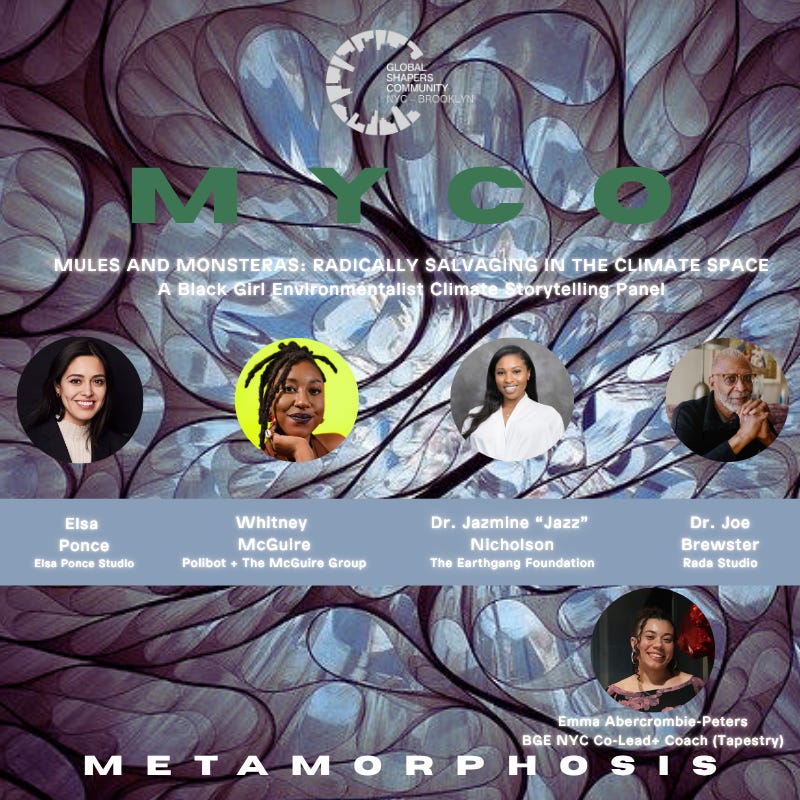
On Saturday, April 18, 2026 I sat on a panel curated by Global Shapers Brooklyn Hub, a community of youth climate organizers here in Brooklyn. The panel was titled: Mules and Monsteras: Radically Salvaging in the Climate Space (A Black Girl Environmentalist Climate Storytelling Panel) and it took place during their inaugural MYCO: Metamorphosis event. The panel opened up dialogue on creative storytelling and preserving climate and cultural histories. My fellow panelists were Joe Brewster, Founder, Rada Studio; Elsa Ponce, Founder of Studio Elsa Ponce; and Dr. Jazmine “Jazz” Nicholson, Executive Director, Earthgang Foundation. It was moderated by Emma Abercrombie-Peters, Sustainability Analyst at Tapestry, Coach (Coachtopia) and she’s a Black Girl Environmentalist Co-Lead.
While I was prepping for this panel, I grappled with a few concepts related to climate narratives, community organizing around climate and sustainability, and why we need to rob institutions. The panel was positioned upon an inquiry: what does it mean to radically salvage and how is this concept articulated in the work we do. Below are some of my thoughts:
“Radical salvage” lands differently for me than most climate language does because salvage implies we are working with what is already here. It is a recovery practice. And that resonates deeply with how I think about community, culture, and creative work in the climate space.
For me, personally, radical salvage looks like refusing to let grief be wasted. My newsletter series, “Grief as Climate Infrastructure,” is premised on the idea that the mourning happening in communities over lost land, lost species, lost ways of life, lost futures is actually data. It is relational knowledge. If we can organize around it rather than suppress it, grief becomes a form of civic infrastructure. That is salvage work.
It also shows up in how I think about African Diasporan cultural knowledge and design justice. There are entire epistemologies — ways of relating to land, time, reciprocity, the body — that have been systematically devalued by the dominant climate conversation. Radical salvage, to me, means going back and saying: this knowledge did not disappear, it was discarded. And the work is to re-center it as viable design logic for what comes next as opposed to nostalgia.
In my consulting practice, in PoliBot, in the white paper I am developing with my collaborators at In Good Company, the through-line is always: what already exists in communities that the mainstream has not recognized as a climate resource? That is the question I keep asking. And the answer is almost always: more than we think.
The Institution Problem
I want to be honest about something: institutions did not just fail to protect these stories. Many of them actively participated in the erasure. So when we talk about radical salvage from inside systems, we have to start there. This is not an accusation as much as it is a design constraint. You cannot fix what you will not name.
That said, I have chosen to work inside these systems, repeatedly and intentionally. And what I have learned is that the work is not to reform the institution from the center. It is to use the institution’s resources to build infrastructure that does not depend on the institution to survive. That is a meaningful distinction. Reform asks the institution to change its values. What I am describing is more surgical — it is about moving resources, relationships, and legitimacy toward communities before the institution can retract them.
Practically, that looks like insisting on community co-authorship, not consultation. There is a difference between an institution asking a community to validate a narrative it has already written, and genuinely building the knowledge infrastructure together. PoliBot was built on that distinction — regulatory intelligence co-authored by environmental justice communities, not just delivered to them.
It also means making the protection architecture explicit. Who owns the story after the exhibition closes? Who holds the archive when the grant runs out? These are not afterthoughts — they have to be negotiated before the institution gets access. I have started treating that negotiation as part of the creative brief itself.
The hardest truth I carry from this work is that institutions will often fund the aesthetics of marginalized climate stories without funding the sovereignty of the communities those stories belong to. Radical salvage demands we close that gap even when, especially when, we are sitting at their table.
Law, Design, and the Architecture of Protection
I sit at the intersection of law and design. As a practitioner of both, I’ve seen the ways these sectors can be both detrimental and generative for creating a habitable future for the global majority.
Law and design are both, at their core, world-making practices. They both answer the question: what do we decide is real, protectable, and worth preserving? The problem is that for most of their histories, both disciplines have been answering that question on behalf of the same narrow set of interests. So when we ask how legal and design frameworks can protect cultural knowledge and memory we are really asking: can these disciplines be retooled to recognize forms of value they were built to ignore?
I think yes. But it requires being very specific about the tools. The frameworks we have — intellectual property, cultural property law, indigenous data sovereignty principles — were designed primarily to protect objects. A song. A textile pattern. A seed variety. But cultural knowledge is not just a set of objects. It is a relational practice. It is the knowledge of when to plant, why it matters, who holds that wisdom and how it gets transmitted. That is much harder to protect with existing frameworks, and in many cases, the act of codifying it into a legal instrument can actually flatten or distort it.
What I have started thinking about — and this is where my legal background and my design practice converge — is using governance design as a protection mechanism. I do this by not just asking what intellectual property a community owns, but: who has decision-making authority over how this knowledge is accessed, used, and shared? Building those structures before an institution, a researcher, or a platform comes in with a proposal. PoliBot is an experiment in that — with this tool, I hope we can build a governance architecture around who co-authors the intelligence it produces.
I teach systems thinking at Parsons, and one of the things I push my students on is this: a value chain is also a story about who matters. When we do circular economy design, we are making decisions, often invisible ones, about whose knowledge gets centered in how materials move, how labor is valued, how waste is defined. Design justice asks us to make those decisions visible and contestable.
Cultural memory and ways of relating to place do not need to be preserved like artifacts in a museum. They need to be activated — given room to evolve on their own terms, with the communities that hold them in the lead. The design question is not “how do we protect this” as if it were fragile. It is “how do we build systems where this knowledge has power?” Legal frameworks set the floor — they establish what cannot be taken. Design frameworks build the ceiling — they create the conditions for flourishing. We need both, and we need communities at the table for both.
What Is Most Urgently at Risk
The practice I believe is most urgently at risk of being lost, or more accurately, most urgently at risk of being further buried, is the knowledge of how to grieve collectively, in ways that produce action rather than paralysis.
I do not mean grief as metaphor. I mean specific, embodied, community-held practices, many of them rooted in African Diasporan tradition, for processing catastrophic loss in ways that reconstitute a community rather than fragment it. The ring shout. The second line. The way certain Caribbean agricultural communities mark the death of a crop season not as failure but as ceremony, as transition. These are not just cultural artifacts. They are climate technologies. They are the original infrastructure for surviving the unsurvivable.
And right now, as communities face compounding climate loss of land, of seasons, of species, of futures that were promised, we are reaching for grief frameworks that were built by and for a very different kind of loss. Individual. Private. Pathologized.
This is why I started “Grief as Climate Infrastructure.” I keep watching communities absorb loss after loss with nowhere to put it collectively and I keep seeing how that unprocessed grief is being weaponized, turned into despair, into withdrawal, into the kind of political disengagement that serves no one except the people who caused the crisis.
Locally, there are highrises popping up all over Bedstuy where sightlines and sunrises used to be. We are witnessing the encroachment of people who never had the best interests of the prior inhabitants at heart. We are witnessing Black Lives not Mattering in the form of development companies, deed theft and predatory lending practices.
So who should be telling these stories if they are not being heard already? I want to be careful here, because the question contains a trap. The communities who hold these practices are already telling them. They have never stopped. The question is who has been listening, and who has been controlling whether those stories get resourced, platformed, and protected. My role as someone who moves between communities and institutions is not to tell the story. It is to use whatever access and legitimacy I have accumulated to make sure the people who hold this knowledge have the infrastructure to tell it on their own terms. To make sure the archive does not live in someone else’s database. To make sure the grief practice does not get extracted, repackaged, and sold back as a wellness product.
The story belongs to the people who survived long enough to carry it. My job, our job, is to make sure they have the room, the resources, and the authority to decide what happens to it next.
What a Climate-Just Future Feels Like
I want to resist the urge to describe a future that looks like a cleaner version of now. Better policy. More diverse boardrooms. Greener infrastructure. Those things matter but they are not what I reach for when I let myself actually imagine forward.
A climate-just future, to me, sounds like block parties and basement bashments on any given summer weekend. It sounds like a neighborhood where the people who have lived somewhere for generations are still there — not displaced by the very green investments that were supposed to save them. Where you can hear multiple languages at a community meeting about a waterway or new development and all of them are treated as equally authoritative about what that water or building means.
It looks like slowness being valued. I mean that seriously. A climate-just future looks like communities having enough time, enough economic security, enough political protection, to do things the long way. To grow food in ways that take years to learn. To make decisions by consensus rather than crisis. To teach children practices that cannot be downloaded. Slowness, right now, is a form of resistance. In a just future, it would simply be called living.
And it feels like grief that has somewhere to go. Not grief that disappears, because loss is real and it will continue to be real. But grief that moves through a community and comes out the other side as something. As a garden. As a policy. As a procession. As a meal that somebody’s grandmother knew how to make and somebody’s son is now learning.
That is actually what the white paper I am developing with my collaborators at In Good Company is trying to hold. We are drafting a cookbook as a container for all of it: Recipes as memory; As loss; As adaptation; As the thing you pass forward when you cannot pass forward the land itself.
A climate-just future feels like knowing that what you carry: the knowledge, the practice, the story, the way you set a table or plant a seed or sing someone home, has a place to land. That it will not be extracted or erased or monetized beyond recognition. That it will be received.
That is what I am working toward. And honestly? That is what keeps me in this work when the scale of the crisis could otherwise be paralyzing.
 | A guest post by
|
Powerful read. I look forward to coming back to this.